Prices checked against Disney’s website on October 19, 2026.
Five park days. That’s our answer for most first trips, and it comes from arithmetic, not a feeling. Walt Disney World has four theme parks, and on Disney’s current prices the fifth day of a ticket costs a fraction of the fourth. Here’s the math, and then how to turn the number into an actual plan.
What there is to fit in
Walt Disney World has four theme parks: Magic Kingdom, EPCOT, Disney’s Hollywood Studios and Disney’s Animal Kingdom. It also has two water parks, Typhoon Lagoon and Blizzard Beach, and Disney currently lists Typhoon Lagoon as temporarily closed.
A standard ticket gets you into one theme park per day. Going to more than one park on the same day takes the Park Hopper option. Water park visits take the Water Park and Sports option, or Park Hopper Plus, which bundles both.
So on a standard ticket, four days is the floor if you want to see every theme park once. Everything past four is a choice about what to repeat.
What each extra day actually costs
Disney prices multi-day tickets per day, and the per-day price drops as the ticket gets longer. Disney’s own line for it is “the more you play the less you pay per day.” The per-day price isn’t the useful number, though. What you want to know is what each added day costs, so we priced one start date at every length and subtracted.
Here’s a trip starting Tuesday, January 12, 2027, one park per day, per person aged 10 and up, before tax:
| Ticket length | Ticket price | What that day added |
|---|---|---|
| 3 days | $530.14 | |
| 4 days | $683.79 | $153.65 |
| 5 days | $726.30 | $42.51 |
| 6 days | $767.03 | $40.73 |
| 7 days | $788.22 | $21.19 |
The fourth day costs nearly as much as each of the first three. The fifth costs less than a third of that, and every day after it costs less again. That’s the whole case for five.
The size of the drop moves with your dates, but it showed up on every start date we checked.
Don’t do this math with Disney’s headline “from” prices. Each one is the lowest price for that ticket length on any date, and the dates differ, so subtracting one from another gives you a number no real trip will see. Price your own start date instead: on Disney’s ticket page, pick a length, pick your date and note the total, then do the same for the next length up.
Park days are not trip days
A ticket counts the days you go into a park. Your trip also has the days you travel.
If you arrive and leave on days you won’t use a park, five park days is a seven day, six night trip. If you plan to use a park on arrival day, it’s one night shorter.
Rest days fit inside the ticket. Disney says its multi-day tickets “can be used on non-consecutive days,” within a window that starts on your start date. For the trip we priced, starting January 12, a 3-day ticket could be used across 5 calendar days, a 4-day across 7, a 5-day across 8, a 6-day across 9 and a 7-day across 10. So a 5-day ticket leaves room for up to three days off, as long as they fall inside those 8 days.
Three ways to lay it out
These are layouts, not advice about which park to do when. They’re what the arithmetic above allows.
Three park days. One short of the four parks. Either pick three, or add Park Hopper and split days between parks.
Five park days. Each park once, plus one day to go back to whichever park you liked most. This is the layout the price table points at.
Seven park days. Each park once, plus three days to repeat, or to spend at a water park with the Water Park and Sports option. Days six and seven added $61.92 between them in the table above.
What a trip of that length costs
Tickets are one line of a trip. Rooms are charged by the night and food by the day, so the extra park day that costs $42.51 on the ticket usually brings a night and a day of meals with it. If you’re weighing four days against five, price the whole thing: here’s what a trip of that length costs, and how to work out yours.
Laying it out in Schedule Summary
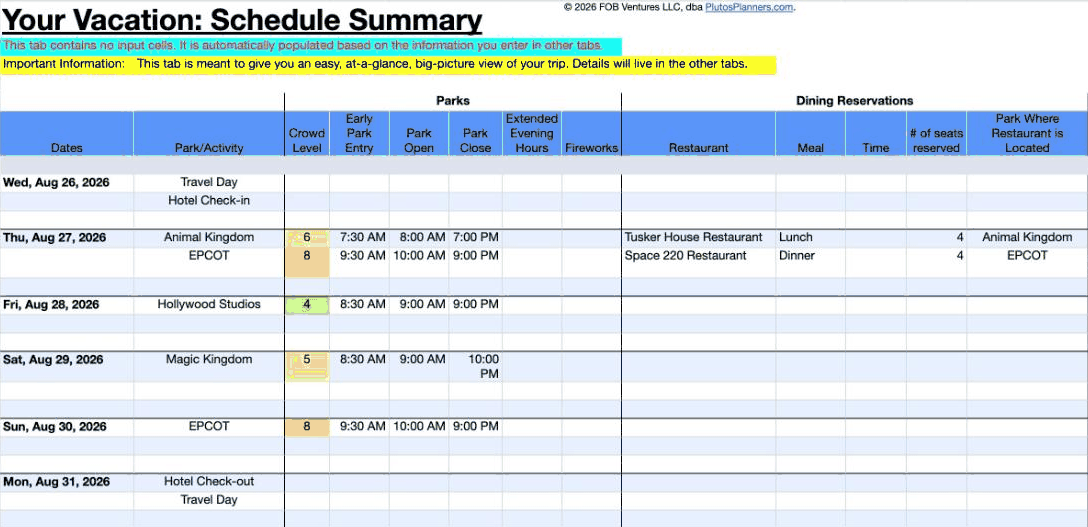
Once you’ve picked a number, the planner lays the days out for you. You enter your first date on the 1) Tickets & Park Reservations tab and the rest of the dates fill in. For each day you choose from a dropdown: any of the four theme parks, either water park, Travel Day, Hotel Check-in, Hotel Check-out, a few other Disney activities, or Other. Crowd levels and park hours fill in from the 1.2) Park Hours tab.
Schedule Summary then pulls it all onto one page, with nothing to type. Each date gets up to three lines, one per park or activity, with early park entry, opening and closing times, Extended Evening Hours and fireworks alongside. Any dining reservations you’ve entered show up on the same day: restaurant, meal, time, party size and which park it’s in. It runs for 12 days from your first date.
It also keeps the two numbers from earlier apart. Park days sit on your ticket row. Vacation days, travel included, are counted on the park plan. The planner’s sample trip runs Wednesday to Monday: six vacation days, with travel and hotel check-in at the start and check-out and travel at the end.
Planning a Disney World trip?
Our free planner is a 12-tab spreadsheet that does the math for you, keeps your tickets, dining and resort details in one place, and can be shared with everyone coming along.
Sources
- Walt Disney World, Theme park tickets, checked October 19, 2026. Ticket prices by length and start date, “1 park per day”, non-consecutive use and usage windows, the four theme parks.
- Walt Disney World, Tickets, checked September 24, 2026. Park Hopper, Park Hopper Plus, Water Park and Sports.
- Walt Disney World, Water parks, checked October 19, 2026. Typhoon Lagoon and Blizzard Beach, Typhoon Lagoon closure.